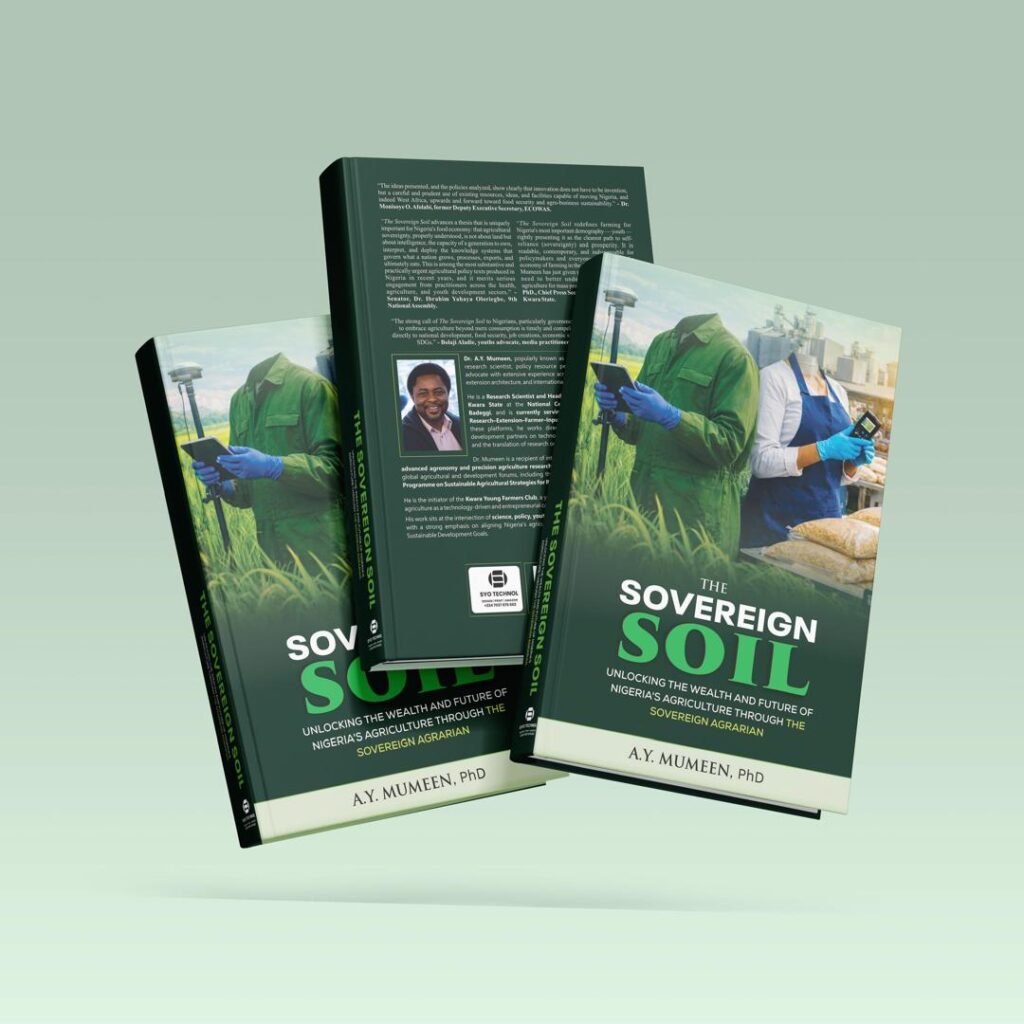
The Sovereign Soil, authored by Dr. A.Y. Mumeen, Lead Researcher at the National Cereals Research Institute (NCRI), is a thought-provoking book aimed at inspiring meaningful policy reforms in Nigeria’s agricultural sector.
Drawing from nearly three decades of practical experience and extensive research, the book offers fresh perspectives on how agriculture can become a stronger driver of national development.
Adding weight to the publication is the foreword written by Professor Lateef Sanni, Executive Director/CEO of the Nigerian Stored Products Research Institute (NSPRI), Ilorin. In his remarks, he highlights the relevance of the book in reshaping perceptions about agriculture and bridging the generational gap in the sector.
Foreword
Agriculture remains one of the most vital sectors for driving economic growth, ensuring food security, and promoting inclusive development in Nigeria and across Africa. Yet, despite the continent’s rich natural resources and human capital, the sector continues to perform below its true potential. This challenge is not necessarily due to a lack of effort, but often because of a disconnect between knowledge and practice, between systems and stakeholders, and between policy goals and on-the-ground realities.
In The Sovereign Soil, Dr. A.Y. Mumeen addresses these gaps with clarity and insight. He challenges the long-standing perception of agriculture as merely a subsistence occupation or a backup plan, presenting it instead as a structured, knowledge-driven enterprise that requires strategic coordination, informed participation, and practical understanding.
At the heart of the book is the concept of the “Sovereign Agrarian”—a farmer who is empowered not only by access to land but also by the knowledge and ability to navigate systems, markets, and opportunities effectively. This idea shifts the focus from mere hard work to smart engagement, where success depends on alignment, timing, and informed decision-making.
The book speaks strongly to the younger generation, especially Gen Z, whose familiarity with digital systems and platform-based solutions can become a major advantage in agriculture. By comparing agricultural systems to digital coordination models, Dr. Mumeen introduces a new perspective where access, aggregation, and timing can create value and efficiency. This approach repositions agriculture as an innovative space where young people can thrive.
READ ALSO: Insecurity: Kwara Private Security Firms Seek Residents’ Support in Crime Reporting
Another major strength of the book is its emphasis on the often-overlooked stages beyond production. It draws attention to the “hidden middle”—the processes of storage, preservation, processing, and market positioning that determine whether value is retained after harvest. In today’s climate of economic uncertainty and environmental challenges, improving post-harvest systems and value addition is essential. This aligns closely with the mandate of NSPRI, whose work continues to create opportunities beyond the farm gate.
The book also recognizes agriculture as part of a global value chain. By encouraging farmers to think beyond local markets and embrace export opportunities, it highlights the sector’s potential to generate foreign exchange, improve competitiveness, and strengthen Nigeria’s economic standing.
One of the book’s most important contributions is its call for better alignment between agricultural policies and production timelines. It points out the persistent mismatch between government budgeting processes and the biological realities of farming, a structural issue that continues to hinder productivity and sector growth.
These ideas are rooted in Dr. Mumeen’s rich experience in agricultural research, extension services, institutional leadership, and global exposure—making the book both credible and practical.
The Sovereign Soil is timely, relevant, and necessary. It challenges policymakers, agricultural stakeholders, and emerging entrepreneurs to move away from fragmented efforts and embrace a more strategic and value-driven approach to agriculture.
This book offers a meaningful contribution to the ongoing conversation about the future of agriculture in Nigeria. It presents a bold and practical vision for building a stronger, more innovative, and economically viable agricultural sector.